Japanese Colors
Colors / Yellow in Japan / Asagiiro

Asagiiro — the Shinsengumi blue

浅黄色 · あさぎいろ · “Light yellow”

A pale kariyasu yellow — asaki-ki, the "shallow yellow" grade of the court dyehouse, one step below deep yellow. Not to be confused with asagi 浅葱, the pale indigo that shares its reading.

Hex
tap to copy
RGB
HSL
CMYK
Text on it
white 1.51 × black 13.94 AAA
Sources
ja.wikipedia #FFCC33 · en.wikipedia #F7BB7D
Download
Save

The story

Asagi is remembered on two uniforms: the haori of the Shinsengumi, the shogunate's swordsmen, whose asagi coats with mountain-stripe hems are now pop-culture icons; and the asagi under-linings of unfashionable country samurai, mocked in Edo comedies as 'asagi-ura' — the color of a bumpkin. One shade, two reputations.
How it was dyed in 927

The Engishiki — the court regulations completed in 927 — records exactly what the palace dyehouse was allotted to dye this color. Quantities are per bolt of cloth; units are left in the original (1 kin ≈ 600 g, 1 shō ≈ 0.7 L in later standards — Heian equivalents are debated).

浅黄 あさぎ Pale yellow (asagi)

For 1 bolt of twill silk — the same applies to floss-silk pongee, spun-silk pongee and eastern rough silk
苅安草大三斤八両kariyasu grass · 3 kin 8 ryō (large measure)
灰一斗二升lye ash · 1 to 2 shō
薪卅斤firewood · 30 kin

The Engishiki also gives scaled quantities for: 1 bolt of plain silk · 1 skein of silk thread.

Original text 原文

浅黄綾一疋、〈綿紬・糸紬・東絁亦同、〉苅安草大三斤八両、灰一斗二升、薪卅斤、帛一疋、苅安草大二斤、糸一絇、苅安草大十一両、灰二升、薪廿斤、

Text: 『デジタル延喜式』校訂文(縫殿寮), National Museum of Japanese History · 1900 printed edition (NDL)

Tints & shades

Harmonies within the tradition

Complementary and triadic companions, chosen from real traditional colors — not computed values.

Similar colors

The namesake

刈安 黄染め — what the name literally points to.

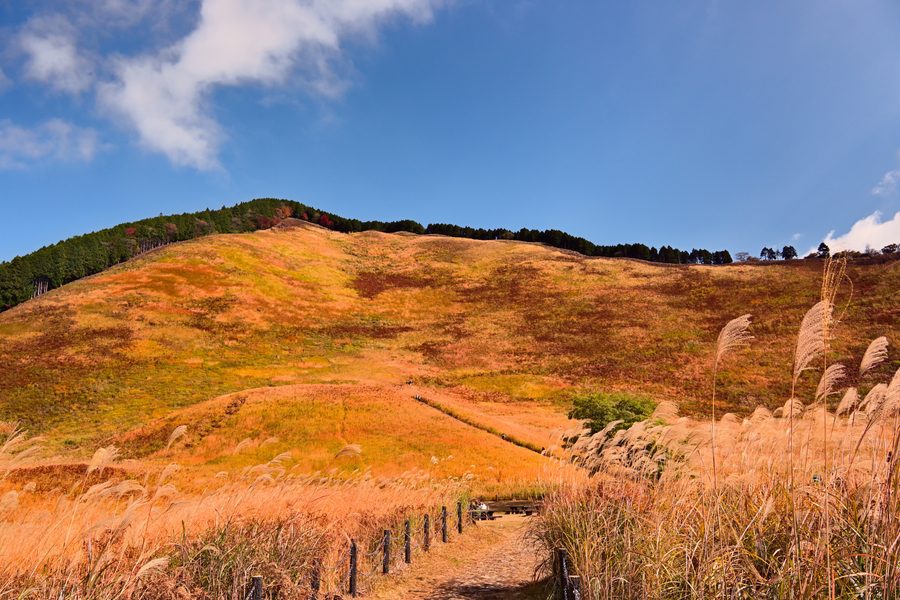
Golden autumn grassland — the kariyasu grass used for yellow dye